“Amanda Palmer…the one from TED Talks?”
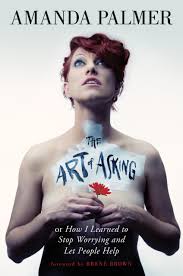
I really didn’t know what to make of Amanda Palmer other than being this eccentric creature submersed in her artwork. Neither had I listened to any of her music prior to reading her memoir nor did I stay religiously up to date on her revolutionary upheaval of the music industry. Amanda Palmer’s memoir The Art of Asking: How I Learned to Stop Worrying and Let People Help replaces the unknown I previously had about her, capturing Amanda Palmer both as an artist and a person. Famous for successfully using Kickstarter as a means of crowdsourcing to release an album and continuing this way of practice in promoting and selling her later work, she confesses her insecurities in this memoir: from asking her fans for donations to her fear of being seen as a narcissist, self-serving poser.
To encapsulate, Amanda Palmer is a musician whose art is best described as eclectic; she uses different instruments and incorporates unique, experimental styles to form these raw and tonal sounds. Plus, she plays the ukulele. The Art of Asking is the unabridged version of her 2012 Ted Talk as well as her band’s war against her record label. The memoir delves into her relationship with famous author Neal Gaiman and her lifelong mentor and friend Anthony, who was living with cancer during the book’s conception. Most of the book, however, is a descriptive catalog of astonishing—but not always—instances where Palmer asks her fans for help and not just in the form of currency (housing, food, venues, etc.) Palmer leaves herself incredibly susceptible to the generosity of others. Although Palmer has witnessed the capacity of human kindness through her art and openness in accepting whatever the fans are willing to offer, she has to contend with being heavily criticized and occasionally painted as a shameful beggar in mainstream media. After reading her memoir though, she’s anything but a beggar and more of an entrepreneur.
Palmer explains that much of what she learned came from her years as a performance artist, her days as a living statue. While she originally did it to be her own boss and still be able to do art, remarking on the conundrum of having a liberal arts degree but not having an itinerary in pursuing a career in the arts, she engaged with her audience on an personal level through mostly an unspoken language and penetrating eye contact, conveying that she had truly seen them versus only looking at them. Palmer realized that finding that connection, even a tiny exposure of intimacy, is what most anyone needs, and she is ready to give it.
Is the Art of Asking a smooth and tired joyride of one person getting exactly what she wants?
No.
Make that a hard no.
Palmer struggled with finances along with her own pride; her memoir illustrates this in the case of her husband. After Palmer assembled a new band and wanted to go on tour, she tried to figure out how she would come up with the money to pay everyone. Her husband offered to loan her the money (though he didn’t expect her to pay him back) but this made her extremely uncomfortable. She had already accepted money from complete strangers, however, accepting money from her husband felt like it would be violating her feminist principles. Only when she sets her pride aside does she recognize the hypocrisy. Then there are times when Palmer doesn’t receive any help even after asking. After Palmer hurt her ankle while running, the three people she asked for help didn’t offer any assistance other than to call an ambulance, ergo, treating her like someone else’s problem. Living a life where you put your faith in others has also landed her in unfavorable sometimes disconcerting situations. One of her fans stole her favorite ukulele at one of her shows. It’s eventually returned but not after Palmer mourned over its loss for two weeks. At another show, a fan shoved a hand between Palmer’s legs while she’s crowd surfacing–and in a not so accidental way. Despite this, Palmer treats each mishap and break in trust as an isolated incident instead of empirically; she doesn’t apply one instance as a universal reason to mistrust everyone nor does she ever seem to hold a grudge.
Palmer’s lifestyle, willing to ask people for help for anything, is an extreme case, but it reveals what most of us are reluctant to do, even when we find ourselves in trouble, even when it’s irrational not to. Most of us are resistant to the idea of putting ourselves in someone else’s care because of its implications. That they are weak, incompetent. A failure. Or when we want something, such as asking for a raise or help changing a flat tire, we synonymously treat ‘asking’ like ‘begging,’ which Palmer is quick to clarify the difference: begging happens out of fear and desperation whereas asking occurs out of need and compassion. Palmer’s memoir captures the general goodness of people if you open yourself to them—but she’s not insisting everyone do this. She’s been lucky, and she knows it.
What we find is something remarkably rare and beautiful in this memoir, leading us to believe that maybe opening ourselves to others isn’t as scary or deadly as we feel it is. Then again, as Palmer puts it, if it were so easy, then everyone would be doing it.

 is. Conveying it to family and friends who seem to have their lives all figured out is worse because you can’t really talk to them without spilling out every thought in your head and leaving them to pick through the rubble of all your what-if future ambitions. If you don’t have a plan within a certain time frame, then comes the advice. Even if it’s coming from a place of good intentions, it’s still frustrating and often comes off as condescending. Of course you’ve updated your resume, checked out that firm, talked to that guy, volunteered at that sheltered, contacted that old boss of yours for a recommendation letter, etc. Chances are that whatever they think you should do is probably something you’ve already tried before, the impulse to yell or rip their hair from their roots suddenly not sounding so crazy.

 Chick lit needs to go away.
 Jennifer Niven’s novel All the Bright Places will be the novel I recommend to anyone desperately in need of the feels. Its subject is not without its controversy and emotionally hard to process, but Places is beautiful and finds the extraordinary in everyday places (and being a Midwestern native who knows our hills are more like lumps—I should know.) It makes us reexamine our current criteria of living, if we’re really ‘awake’ or just going through the motions. Violet and Finch meet on the ledge of a bell tower for similar reasons with different purposes. The novel examines two young adults both caught up in their own struggles. While Finch is obsessed with death, Violet is just looking for a way out. Although this sounds like the worst pairing, both of them rediscover passion and excitement, but even love is not enough to keep someone going. Places is a reminder that amid loss and death, people somehow solider on.
 I’ll Give You The Sun by Jandy Nelson is a beautiful, coming-of-age story about finding yourself when everything feels shared, less, or not your own. The death of their mother significantly changes Noah and Jude, fraternal twins struggling to feel a sense of belonging. Sun is narrated by the shifting perspectives of Noah and Jude, from the year before their mother’s death to three years later. Even before the life-changing event, Noah and Jude were opposites in every way, competitive for their parents’ attention and a yearning for acceptance, but once things change, they flip personas. Sun creates a vacuum only for self-discovery with everything and everyone being conveniently pulled to one place. It’s about breaking free of encumbering labels, self-perpetuating guilt and shame, and rediscovering the magic.
 My thoughts on marriage are what you call ‘a glass-half empty,’ the scope of marriage like a cone, open and wide at the start but narrowing as time passes, which, subsequently, outlines the majority of novels about marriages. Rarely do I read books from this sub-genre in Adult Fiction because these novels, more often than not, transfigure married couples into conjoined twins, making them a unit instead of two, separate beings. Sure, they may care deeply for the other—
